
AI Readiness Matrix: A Prioritization Framework
A framework for evaluating which processes are ready for AI — prioritizing investments by business value, workflow readiness, and data quality.
The Problem with AI Hype
Every vendor will tell you their AI tool can transform your business. Fewer can explain which problem it solves, whether your workflow is ready for it, or what needs to be true for the tool to work after the demo is over.
The result? Expensive software subscriptions that do not get adopted, automation that breaks existing workflows, and business leaders who feel burned by “AI transformation.”
This framework helps you evaluate two critical dimensions before you commit to a solution:
- Business Value – How much impact would automation actually have?
- Organizational Readiness – Does your business have the data, workflows, ownership, and team capacity needed to make the tool work?
Use this framework when you are considering an AI tool, automation platform, or workflow upgrade and need to decide whether the process is ready, valuable, and worth funding now.
What Organizational Readiness Means
Organizational readiness means more than technical interest. It means your business has enough structure to support the tool after purchase.
A process is more ready for AI or automation when:
- The workflow is documented or at least consistently understood
- The data is clean, accessible, and reasonably standardized
- Someone owns the process and can make decisions about it
- The team has capacity to test, adjust, and maintain the tool
- The business problem is specific enough to evaluate success
AI does not remove the need for workflow clarity. In many cases, it increases the need for it.
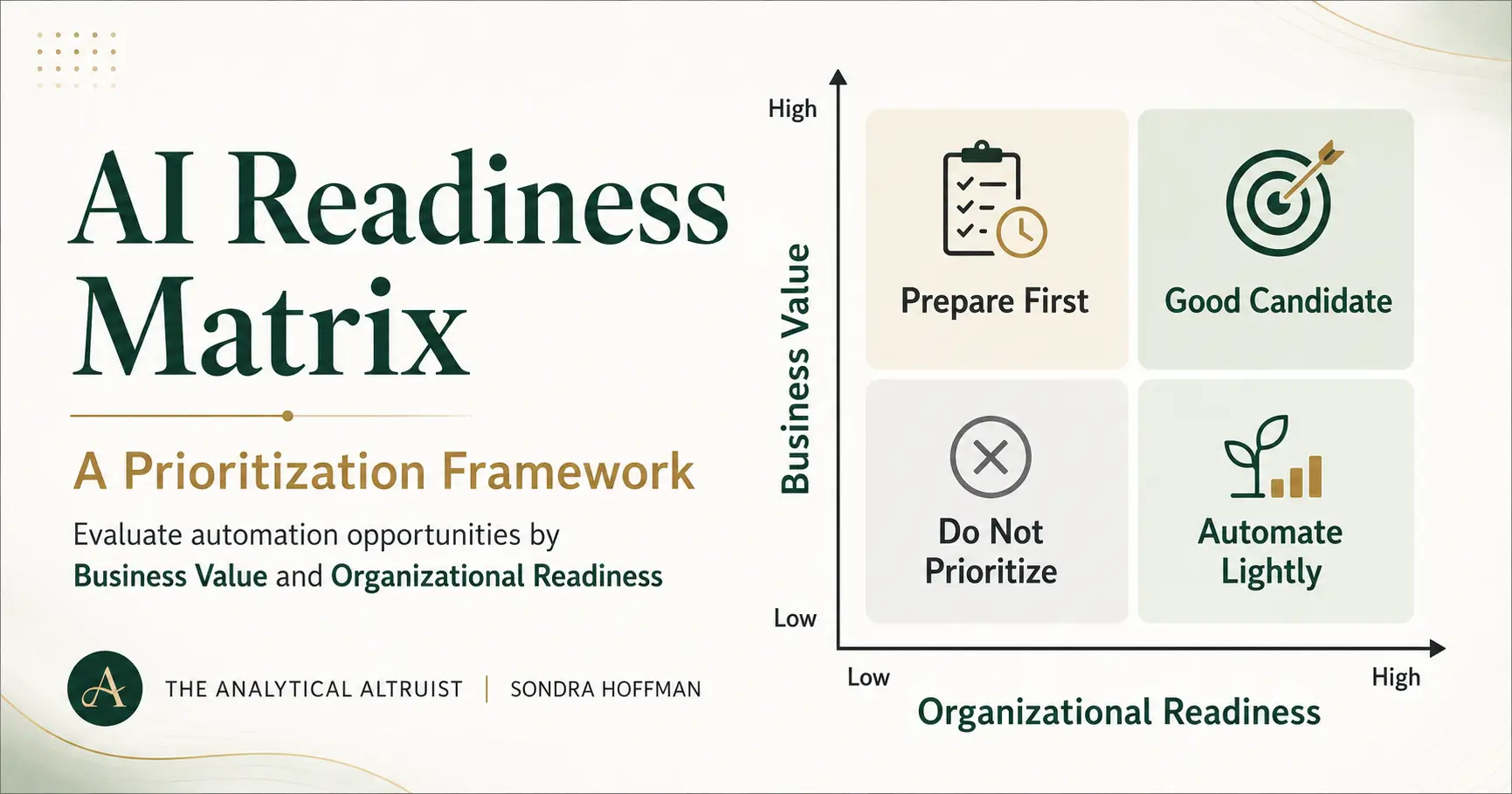
The AI Readiness Matrix
High Value / High Readiness
Status: ✅ Good Candidate
Action: Prioritize these opportunities. The business value is clear, and the organization has enough workflow structure, data quality, and ownership to execute successfully.
Examples:
- Document classification when naming conventions are already consistent
- Invoice processing when the AP workflow is standardized
- Customer inquiry routing when categories are well-defined
What to watch: Do not over-engineer. Start with the simplest solution that solves the problem.
High Value / Low Readiness
Status: ⚠️ Prepare First
Action: Do not automate yet. The opportunity matters, but the organization needs preparation before committing to an AI solution.
Examples:
- Data extraction from inconsistent document formats
- Predictive analytics when historical data is incomplete or unreliable
- Workflow automation when current processes are not documented
What to do: Clean up workflows, standardize data, document processes, assign ownership, and then re-evaluate.
Low Value / High Readiness
Status: 🔧 Automate Lightly
Action: These may be low-hanging fruit. Automate if the solution is inexpensive, easy to maintain, and does not distract from higher-value work.
Examples:
- Meeting transcription for internal notes
- Email auto-replies for low-priority inquiries
- Social media post scheduling
What to watch: Do not let vendors upsell enterprise features for a low-impact process.
Low Value / Low Readiness
Status: 🚫 Do Not Prioritize
Action: Say no for now. This is where budgets, attention, and staff trust can disappear.
Examples:
- AI tools for processes that rarely happen
- Automation for workflows that are still changing
- “AI transformation” initiatives without a specific problem statement
What to do: Redirect resources to higher-value opportunities. Revisit only if the business value increases or the process becomes more stable.
Matrix Summary
| Quadrant | What It Means | Best Next Step |
|---|---|---|
| High Value / High Readiness | The opportunity is important and the organization is prepared enough to act. | Evaluate vendors, design a pilot, and define success metrics. |
| High Value / Low Readiness | The problem matters, but the foundation is not ready. | Prepare the workflow, clean up data, assign ownership, and revisit. |
| Low Value / High Readiness | The process is easy to automate but not strategically important. | Automate lightly only if the cost and effort are low. |
| Low Value / Low Readiness | The opportunity is neither urgent nor ready. | Say no, defer, or redirect resources. |
Quick Scoring Method
For each process, rate both dimensions from 1 to 5.
Business Value
| Score | Meaning |
|---|---|
| 1 | Nice to have, but not tied to meaningful business outcomes |
| 2 | Some convenience value, but limited operational impact |
| 3 | Useful, but not urgent or high-risk |
| 4 | Meaningful time savings, quality improvement, or operational benefit |
| 5 | Directly affects revenue, compliance, customer experience, risk, or major labor cost |
Organizational Readiness
| Score | Meaning |
|---|---|
| 1 | Process is undocumented, inconsistent, or dependent on individual memory |
| 2 | Some structure exists, but data quality or workflow consistency is weak |
| 3 | Partially ready, but ownership, data, or adoption capacity is uneven |
| 4 | Workflow is mostly consistent, and implementation ownership is realistic |
| 5 | Process is documented, data is accessible, and the team can test and maintain the solution |
How to Plot the Process
Use this simple rule:
- Scores of 4–5 = High
- Scores of 1–3 = Low
Then plot the process on the matrix:
- High Business Value + High Readiness = Good Candidate
- High Business Value + Low Readiness = Prepare First
- Low Business Value + High Readiness = Automate Lightly
- Low Business Value + Low Readiness = Do Not Prioritize
This scoring method is intentionally simple. It is not meant to replace deeper analysis. It is meant to slow down the decision long enough to ask better questions before money is spent.
How to Use This Framework
Step 1: Identify a Specific Process
Do not start with “We need AI.” Start with a concrete business process.
Examples:
- Reviewing building permits for compliance issues
- Matching invoices to purchase orders
- Categorizing project documents
- Routing customer service tickets to the right team member
- Summarizing intake forms before staff review
Bad starting point: “We need to use AI to improve efficiency.” Better starting point: “We spend 8 hours per week manually categorizing project documents.”
The more specific the process, the easier it is to evaluate whether AI is the right tool.
Step 2: Assess Business Value
Ask:
- How much time or money does this process cost now?
- What happens if the process is done incorrectly?
- How often does the process happen?
- Does the process affect revenue, compliance, risk, customer experience, or staff capacity?
- Would automation improve the outcome, or simply move the problem somewhere else?
High business value examples:
- Compliance-critical document review
- Invoice processing that delays payment or damages vendor relationships
- Customer intake that directly affects revenue
- Reporting processes used for operational or financial decisions
Low business value examples:
- Tasks that happen rarely
- Processes where manual judgment adds meaningful value
- “Nice to have” features that do not tie to business outcomes
- Automation that saves minutes but adds maintenance burden
Step 3: Assess Organizational Readiness
Ask:
- Is the underlying data clean, consistent, and accessible?
- Are the current workflows documented or at least standardized?
- Does the team agree on how the process should work?
- Is there someone who can own the implementation?
- Can the team test, adjust, and maintain the tool after launch?
- What happens when the tool gets something wrong?
- If the tool or underlying model became unavailable, could you substitute it without rebuilding the workflow?
High readiness indicators:
- Existing process documentation
- Consistent data formats and naming conventions
- Clear ownership
- Internal expert who understands both the process and the technology
- Team capacity to test, iterate, and refine
Low readiness indicators:
- “We will figure out the data later”
- Workflows that differ by person, team, location, or project
- Hoping AI will “fix” a broken process
- No one has time to manage the implementation
- No clear standard for what a correct output looks like
Step 4: Plot the Process and Decide
Once you have assessed business value and organizational readiness, place the process in one of the four quadrants.
✅ High Value + High Readiness Move forward with a focused evaluation. Define success metrics, compare vendors against your actual requirements, and start with a limited pilot.
⚠️ High Value + Low Readiness Pause before buying. This may be an important opportunity, but preparation comes first. Standardize workflows, clean up data, document the process, and assign ownership.
🔧 Low Value + High Readiness Automate lightly if the solution is simple and low-cost. Avoid custom builds or expensive platforms for low-impact work.
🚫 Low Value + Low Readiness Say no for now. Redirect attention to work that is either more valuable, more ready, or both.
Real Example: Construction Document Classification
The pitch: “Our AI will automatically classify and route your project documents — drawings, RFIs, submittals, contracts — so your team never has to manually file anything again.”
It sounds useful. But before buying, apply the framework.
Business Value Assessment
- Current cost: Project managers spend time each week manually filing documents
- Frequency: Daily on active projects
- Risk if wrong: Misfiled documents can delay decisions, create rework, or weaken audit trails
- Business value score: 5
- Verdict: High business value ✅
Readiness Assessment
- Data quality: Document naming varies by subcontractor. Some files are named
RFI_001.pdf; others are namedRequest for Info Smith Electric.docx - Workflow consistency: Each project manager has a different folder structure
- Process documentation: None. “Everyone just knows where things go”
- Ownership: No one has been assigned to maintain document standards
- Readiness score: 2
- Verdict: Low readiness ❌
Matrix Position
High Value / Low Readiness → ⚠️ Prepare First
What to Do Instead
- Standardize naming conventions across subcontractors and internal teams
- Document the folder structure and make it consistent across projects
- Assign ownership for document standards and exceptions
- Train project managers on the new process for 30–60 days
- Then evaluate AI tools using clean, predictable inputs
Result: The AI tool has a better chance of working because the organization prepared the workflow first. Skip the preparation, and the tool may fail no matter how sophisticated the model is.
Common Mistakes
❌ Mistake 1: Skipping the Readiness Assessment
The trap: “The vendor demo worked perfectly. Let’s buy it.”
The reality: Vendor demos usually use clean data, controlled examples, and ideal workflows. Your business may not.
The fix: Audit your actual data, documents, workflows, and ownership before committing.
❌ Mistake 2: Automating Broken Processes
The trap: “This process is inefficient. AI will fix it.”
The reality: Automating a broken process can make the problem move faster and spread farther.
The fix: Improve the process first. Then decide whether automation still makes sense.
❌ Mistake 3: Chasing Low-Value Automation
The trap: “This AI tool is impressive, and our competitor uses it.”
The reality: Impressive does not always mean valuable. A tool that does not solve a specific business problem can become a distraction.
The fix: Tie every AI investment to a measurable business outcome.
❌ Mistake 4: Ignoring the Ownership Question
The trap: “The AI will run itself.”
The reality: Every tool needs an owner. Someone has to monitor results, troubleshoot exceptions, update workflows, and decide when the tool is wrong.
The fix: Assign ownership before you buy. If no one has capacity, the organization is not ready.
❌ Mistake 5: Treating AI as a Strategy Instead of a Tool
The trap: “We need an AI strategy.”
The reality: AI strategy is only useful when it is connected to actual business processes, risks, and decisions.
The fix: Start with the workflow. Then decide whether AI, automation, reporting, better documentation, or a simpler software change is the right next step.
❌ Mistake 6: Underestimating Vendor Continuity Risk
The trap: “Our AI vendor is established and well-funded. We do not need to plan for disruption.”
The reality: A deployed AI model can be removed from the market — by a regulatory directive, a vendor decision, or a contract change — faster than most organizations can respond. A workflow that has a hard dependency on a specific model or API endpoint with no fallback is carrying unmitigated operational risk.
The fix: Before committing to a tool, ask: if this model or vendor became unavailable tomorrow, what would we do? If the answer is “rebuild the workflow,” the dependency is unmitigated. Build fallback capability into critical workflows before you need it.
When to Say No to AI
Sometimes the right answer is “not yet” or “not this.”
Say no when:
- The vendor cannot explain which specific problem the tool solves
- The process is still evolving
- The data is inconsistent, inaccessible, or unreliable
- The team does not have time to implement and maintain the tool
- No one knows who will own the process after launch
- The ROI timeline is vague
- You are being sold a platform when you need a narrow solution
- The proposed tool creates more review work than it saves
- The tool creates a hard dependency on a single AI model or vendor with no viable substitute if that model is discontinued or restricted
Model availability is now a documented risk. A government directive can remove a deployed AI model from the market before most organizations can respond — as the Fable 5 suspension demonstrated. If a workflow cannot tolerate a 24–72 hour model outage, it needs a fallback plan before it needs an AI tool.
Saying no is strategic. It protects your budget, your team’s time, and your organization’s trust in technology decisions.
What Comes After the Matrix?
If you identify a High Value + High Readiness opportunity, the next steps are:
Define success metrics What does “working” look like? For example: “95% of invoices are auto-matched within 24 hours,” or “project documents are classified correctly 90% of the time during the pilot.”
Clarify requirements Identify what the tool must do, what systems it must connect to, what data it needs, and what human review is still required.
Evaluate vendors Compare tools based on your specific requirements, not broad feature lists or demo promises.
Pilot the solution Start small, measure outcomes, document exceptions, and refine before expanding.
Plan for change management Train your team, document the new workflow, assign ownership, and decide how issues will be handled.
For a broader framework on structuring AI investments across the organization, A Strategic AI Blueprint for Businesses covers the strategic layer above individual process decisions.
If you want to work through these steps with your team, the AI Business Resilience Workbook is a $5 guided companion to this framework — scoring tables, vendor continuity worksheets, and a quadrant-specific action plan you fill out as you go.
This is where independent consulting helps. I work through this process with clients — not to sell software, but to make sure the right problem gets solved with the right solution.
Need Help Deciding What Belongs in Each Quadrant?
If you are looking at an AI tool, automation platform, or software upgrade and are not sure whether the opportunity is ready, I can help you evaluate the process before you commit budget.
We will look at:
- Business value
- Workflow readiness
- Data quality
- Ownership
- Adoption capacity
- Vendor fit
- Implementation risk
Then we decide whether to move forward, prepare first, automate lightly, or say no.
The first conversation is free. We will talk through your specific situation, and I will tell you honestly whether what I do is the right fit.
This framework is part of my vendor-neutral consulting practice. I do not resell software, accept referral fees, or receive commissions for recommending tools. My independent advisory work is focused on fit, readiness, and practical business value.